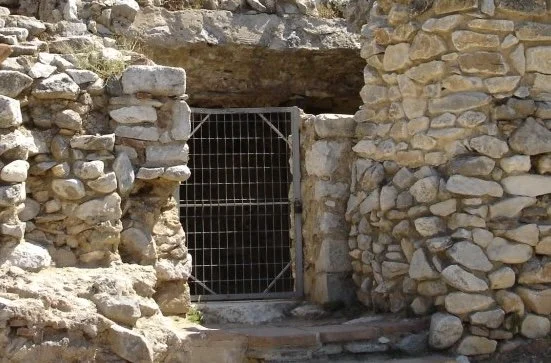
Traditionally the prison cell of Paul and Silas in Philippi
When Paul and Barnabas brought the gospel to Lystra (Acts 14:8–20), some Jewish opponents from Iconium and Antioch stirred up a mob that stoned Paul and dragged him out of the city, where they left him for dead. Paul survived and the next day he and Barnabas departed for Derbe. A short time later they returned to Iconium, Antioch and Lystra to strengthen the disciples, reminding them that, ‘We must go through many hardships to enter the kingdom of God’ (Acts 14:22).
Among the first disciples in Lystra was a young man named Timothy, the son of a believing Jewish mother and a Greek father. When Paul returned to Lystra a couple of years later, he recruited Timothy as a coworker. Over the next fifteen years, he was Paul’s closest companion (Acts 16:1–5).
Paul writes his second letter to Timothy from a jail in Rome. He is awaiting trial and expects to be executed. Paul writes as Timothy’s spiritual father.
Timothy is now the leader of the churches in Ephesus. He is facing threats from within and without—false teachers and false prophets attacking from within; persecutors attacking from without.
I’m interested in what the letter teaches us about persecution.
1. Don’t be ashamed (2 Tim 1:6-18)
Paul is alone, feeling abandoned. Out of fear and shame, the disciples in Asia Minor had deserted him at his trial. All except Onesiphorus, who came to Rome and searched hard to find Paul. Despite the danger, he was not ashamed of Paul’s chains.
Paul urges Timothy not to be ashamed of the gospel of the Lord or of his prisoner in chains. Timothy has experienced the Holy Spirit, and the Spirit does not make us timid but gives power, love, and self-control.
He reminds Timothy of the long history of God’s grace in this life. Timothy’s mother and grandmother taught him the Scriptures. Paul, his father in the Lord, brought him to Christ, taught him, trained him and recruited him as a coworker. The Holy Spirit indwells him, but Timothy must not take that for granted; he must step up, fan into flame God’s gifts, and live out his calling (Stott).
2. Join me (2 Tim 2:1-10)
Paul urges Timothy to be strong in the grace that is in Christ Jesus.
Living in a sinful world, we are tempted to stay silent about the gospel rather than face rejection or to edit the gospel of its offensive elements. We’re happy to proclaim the unconditional love of God in Jesus’ acceptance of sinners, failing to mention his call to those same sinners to repent and believe in him.
When training in evangelism, I had an Iranian tell me you can’t mention ‘sin’ to Iranians; it was not culturally appropriate. Later a Chinese believer told me the same was true of his people. Then I was told ‘post-moderns’ would be alienated by any mention of sin. I realized sin and judgment are not popular in any culture. The Jews and Greeks of Paul and Timothy’s day didn’t want to hear about a crucified Savior who died for their sins. But that’s what they needed to hear. That’s why Christ died.
Like Timothy, we need to hear Paul’s challenge to join him in suffering for the authentic gospel.
3. The last days are here (2 Tim 3:1-9)
The ‘last days’ began with the coming of Jesus and will end when he returns.
We are in them now. Here’s Paul’s description:
‘People will be lovers of themselves, lovers of money, boastful, proud, abusive, disobedient to their parents, ungrateful, unholy, without love, unforgiving, slanderous, without self-control, brutal, not lovers of the good, treacherous, rash, conceited, lovers of pleasure rather than lovers of God— having a form of godliness but denying its power.’
If this is true, we should expect persecution if we remain faithful to the true gospel. Don’t expect heaven on earth on this side of final judgment.
We are to rescue people from a world that is at war with God and his people. We are to expect persecution from without and false teachers and prophets from within.
No one wants to hear that.
Over the last hundred years, the West’s understanding of mission has shifted. Driven by naive optimism, mission has been redefined as the transformation of society. Tell me, which cities did Jesus transform? Which cities did Paul transform? When the gospel arrives, riots erupt. When the dust settles, a new community of disciples forms while the Word continues its journey to the ends of the earth.
We all want to be liked. Who wants to be shamed? But Paul tells Timothy, if you want to live a godly life in Christ Jesus, you will be persecuted. In this world, evildoers and impostors will go from bad to worse, deceiving and being deceived
Expect trouble.
4. Remember (2 Tim 3:10-17)
How is Timothy to stand firm in such a world? Paul says, you must remember. Remember my teaching. Remember my way of life. Remember my example of how to face persecution.
Remember also that since childhood your mother and grandmother taught you from the Scriptures. Those same Scriptures were fulfilled in the salvation that comes from faith in Christ Jesus.
The Scriptures are ‘God-breathed’ and provide you with everything you need to stand firm and serve God.
5. Your assignment (2 Timothy 4:1-8, 14–18)
There is more. Survival is not enough. Timothy has a God-given mission to fulfill.
In the presence of God and of Christ Jesus, who will judge the living and the dead, Paul orders Timothy to preach the Word. Regardless of the situation, the gospel must go out. He is also to apply the Word to believers’ lives with patience and careful instruction.
The Word is key. The Word is to go out. The Word is to be lived out.
Paul reminds Timothy again of his example. Paul is ready to be poured out like a drink offering. He is ready to die. He has fought the fight, finished the race, kept the faith. Paul is not boasting. He’s saying, ‘Timothy, you too can fight this fight, finish this race, keep the faith and you will be rewarded by the Lord with a crown of righteousness.’
Paul recalls one of his persecutors, Alexander the metalworker. He harmed Paul and opposed the message. Timothy should be wary of him but not afraid. God will deal with him.
Paul shares how alone he felt at his first trial. He felt deserted. ‘But the Lord stood at my side and gave me strength, so that through me the message might be fully proclaimed and all the Gentiles might hear it.’
In his hour of weakness, God’s power was revealed and the gospel went out at Paul’s trial. He made it through the ordeal and knows God will rescue him from every evil attack and bring him safely to his heavenly kingdom.
Today
If Paul were in prison somewhere in the world today, on trial for his life, there would be petitions, protests, and political pressure to have him released. And rightly so.
But that’s not how Paul views his predicament. He doesn’t blame the authorities or question God’s love and power. He’s not asking, Why? He’s not a victim.
Paul uses his imprisonment as an opportunity to strengthen the faith and ministry of his ‘son’, Timothy. He is writing so that Timothy might stand strong, unashamed of the gospel and fulfill his part in God’s mission. He hopes that one day Timothy will stand triumphant before the Lord Jesus, who himself triumphed over his persecutors.
Paul often urged the believers to ‘imitate me, as I imitate Christ.’ To our ears, that sounds like a leader with too high a view of himself. Until you meet the disciples who have endured persecution and remained faithful. You see the life of Christ in them and understand what it means to imitate them as they imitate Christ.
Around the world, where there are movements of disciples and churches, there is persecution. Their example of faithful suffering inspires me. Persecution is not common in the Western world; we’ve drifted from the truth of the gospel. Should we return to the core missionary task—multiplying disciples and churches to the glory of God among every people and in every place—then, and only then, can we join with our brothers and sisters around the world in imitating Paul as he imitated the Lord Jesus.