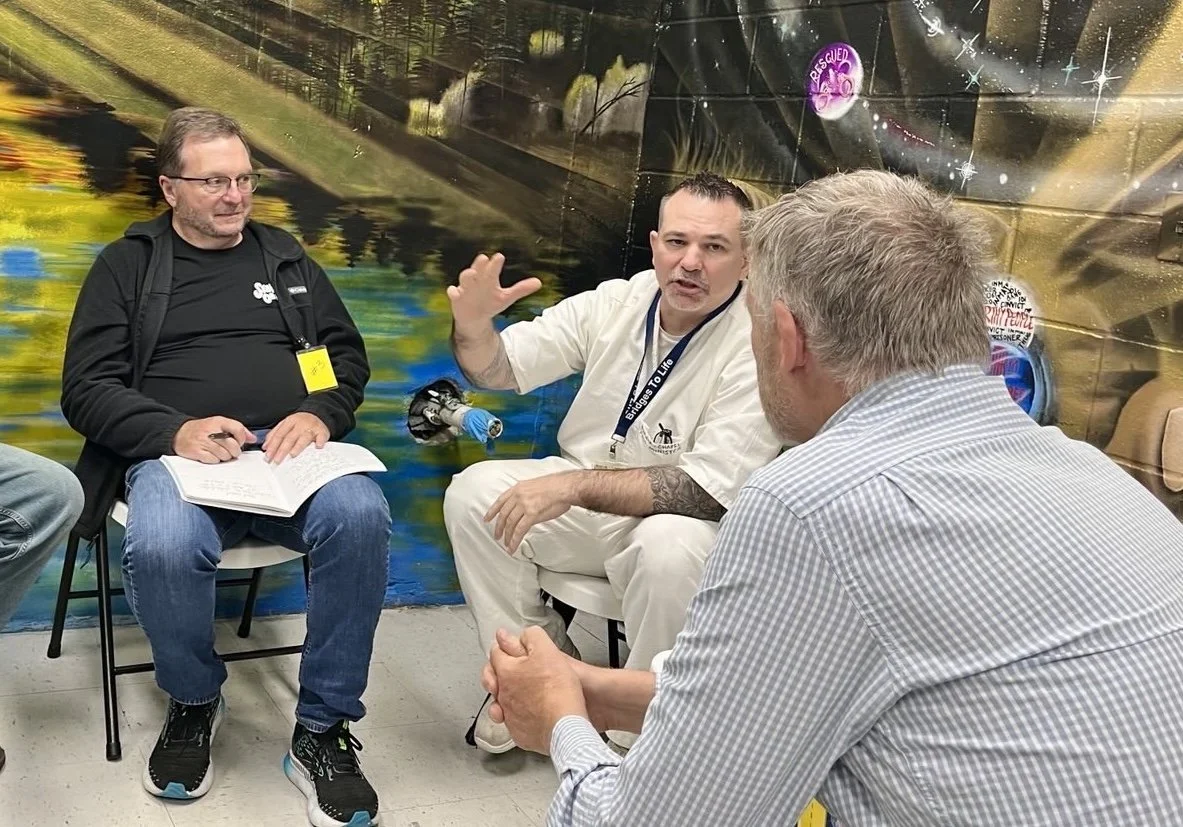
left Don Waybright middle David Ludwick right Steve Addison
The seventh of ten studies from Everywhere: How God Multiplies Disciples and Churches.
In the book of Acts, Luke doesn’t record any mission trips by Paul beyond Ephesus, so it’s widely assumed Paul was in the city for up to three years. Yet, through the disciples he trained, “all the Jews and Greeks who lived in the province of Asia heard the word of the Lord” (Acts 19:10). In Ephesus, Paul worked as an outsider who trained and sent out insiders throughout all of Asia Minor. One insider was Epaphras, who planted churches in the Lycus Valley in the cities of Laodicea, Hierapolis, and Colossae.
Many movements have started with a partnership between an external catalyst and an internal leader. When Don Waybright entered Darrington Prison, Texas, he intended to train disciples to follow Christ and make disciples. He aimed to start a movement that he would not lead—a strategy rooted in his complete confidence in the Word and the Spirit, as well as the clarity of the core missionary task. He provided disciples in prisons with a clear 4-Fields strategy and simple yet effective methods. Don watched for disciples who quickly obeyed and built coaching relationships with them. His focus was on those who shared the vision for a movement of disciples and churches. He coached inside leaders like David Ludwick to take ownership of the core missionary task. As they stepped forward, Don stepped back.
This outsider–insider partnership is a recurring pattern in all our case studies. The same pattern can be seen as Jesus prepared his disciples for his departure.
In India, God brought Gary and Ravi together in an outsider–insider relationship. They were drawn together by their uncompromising commitment to the Great Commission and developed a father-and-son bond. For over seven years, they persisted in refining their methods before achieving a breakthrough. Through the struggle, God shaped their identities.
In Ghana, outsiders Terry and Amy Ruff teamed up with insider Isaac to address challenges related to strategy and methods. Although breakthroughs led to growth, Terry recognized that movements require more than just the correct strategy and processes. He took on a father-figure role to confront Isaac’s moral failure, which was a critical identity issue rooted in disobeying God’s Word and resisting the Holy Spirit. Isaac turned back and was restored.
We see the same outsider–insider pattern in Lebanon with James and Ibrahim. Though James is the outsider, he is half Ibrahim’s age and treats him like a father. Their relationship works because both men practice humility.
Outsiders are clear about their identity, confident in the Word and the Spirit, and committed to the core missionary task. They are not trying to promote their ministry; they are looking for inside leaders. Insiders are resilient and eager to learn. They take responsibility for the core missionary task and demonstrate this through their actions. They are the ones who say, “If no one else will do this, I will!”—even if they don’t know how! Outsiders and insiders are drawn to each other because they share a common heart. Once the partnership is established, they spend significant time together.
For a generation, most movements were built through an outsider–insider partnership, with the outsider often a Westerner. However, outsiders from the non-Western world are now replacing them. Movement practitioner and strategist Stan Parks observes that movements are now “cascading from their initial peoples and places into other peoples and places, both near and far.”
Globally, over 90 percent of new movements in the last five to ten years were started by teams sent out from existing movements—without any involvement from Western cross-cultural workers. It’s not the end of the outsider–insider roles; rather, it signifies the end of reliance on the West.
This is what we hope to see: movements initiating other movements, no longer relying solely on dependence but working together in partnership to fulfill the Great Commission.
For groups and individuals:
Read Acts 20:4, 17–38.
What do we learn about God from this story?
What do we learn about people?
What do we learn about developing inside leaders in movements?
What do you need to do to obey what you’ve learned?