
For I was hungry and you gave me something to eat,
I was thirsty and you gave me something to drink,
I was a stranger and you invited me in,
I needed clothes and you clothed me,
I was sick and you looked after me,
I was in prison and you came to visit me.
Jesus’ mission to Israel was completed, and it was his final week in Jerusalem. As he walked out of the temple for the last time, he announced its destruction.
In his final teaching, he focused on the coming of the glorious Son of Man, and the judgment of the nations at the end of the age.
Eternal life and eternal punishment will depend on how the nations care for the ‘least of his brothers’.
Many scholars understand the least of these brothers of mine to refer to all who are hungry, distressed, and needy. The basis of acceptance into the kingdom is deeds of mercy and compassion. They identify the least of Jesus’ brothers with anyone who is poor and needy.
It’s an important question because it goes to the heart of the missionary task.
New Testament scholar Craig Keener disagrees—not with feeding the poor—but disagrees that that’s what Jesus is talking about here.. When Jesus says in Matthew 25:31–46, “the least of these my brothers” (and sisters) probably refers to those sent to spread the good news.
According to Keener, when others feed them and take them in, they are welcoming Jesus—just as with the apostles earlier sent out in Matthew 10:11–13, 40–42 (compare 2 Cor. 5:20; 6:13). Elsewhere in Matthew, Jesus’s true brothers (and sisters) always refer to his followers (Matt. 12:48–50; 23:8–9; 28:10).
Likewise, those who reject Jesus’s agents and face judgment in 25:41–46 sound like those who rejected Jesus’s agents in 10:13–15.
Notice again the conditions that may characterize Jesus’s agents as they labor for him in Matthew 25: “hungry . . . thirsty . . . needing a place to stay . . . poorly clothed . . . sick . . . imprisoned” (25:35–39, 42–44).
Suffering often occurs in the context of mission.
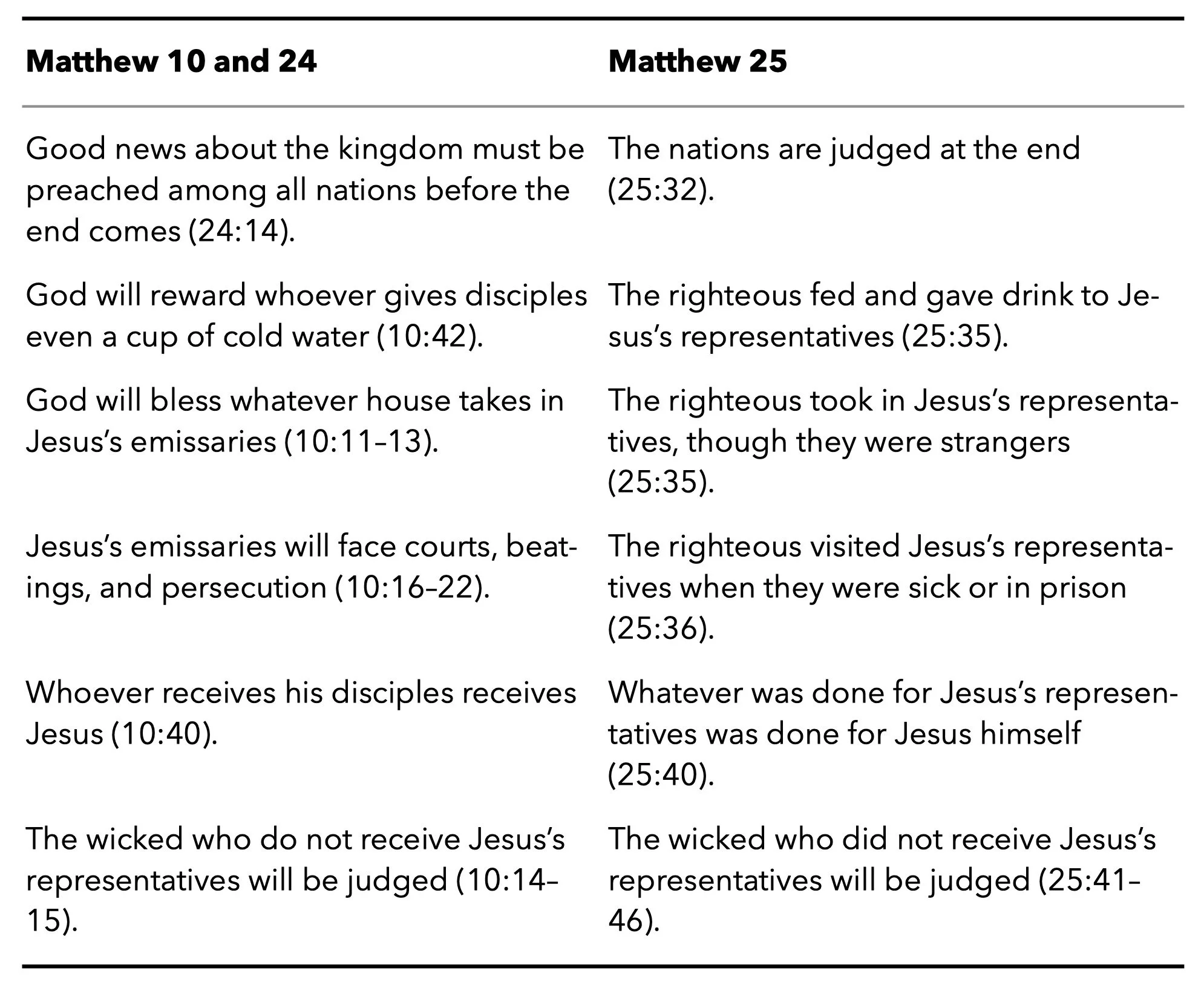
The nations will be judged by how they treat the messengers Jesus sends. He goes with them. Whatever is done to them is being done to Jesus himself. That’s why on the Damascus road Jesus asked Saul, ‘Why do you persecute me?’
Three lessons:
The gospel will go to all nations through Jesus’ messengers.
They are to expect persecution, but Jesus goes with them.
How they are received will decide one’s fate on judgment day.